AI Vacancy Matcher
An explainable vacancy matcher that connects explicit job requirements to verified portfolio evidence instead of producing a vague AI score.
Evidence, evaluation and scope
Explainable by design
Every supported requirement points to published portfolio evidence. Missing evidence is reported explicitly instead of being inferred.
Resilient matching
Deterministic extraction keeps the core analysis available when the AI provider is unavailable or its quota is exhausted.
Measured quality
A versioned evaluation suite blocks regressions in requirement extraction, project selection and unsupported claims.
Security and privacy
Server-only credentials, request masking, strict validation, origin checks, rate limiting and an authenticated private service reduce exposure.
Current evaluation scope
The current deterministic evaluation set covers Dutch and English frontend, full-stack, applied-AI and platform vacancies. It currently reports 100% requirement precision, requirement recall and evidence accuracy, with zero unsupported claims on that defined set.
Known boundaries
Unusual synonyms, complex negations, either-or conditions and technologies outside the current taxonomy may still require additional evaluation. The interface reports missing evidence instead of silently inventing a match.
Overview
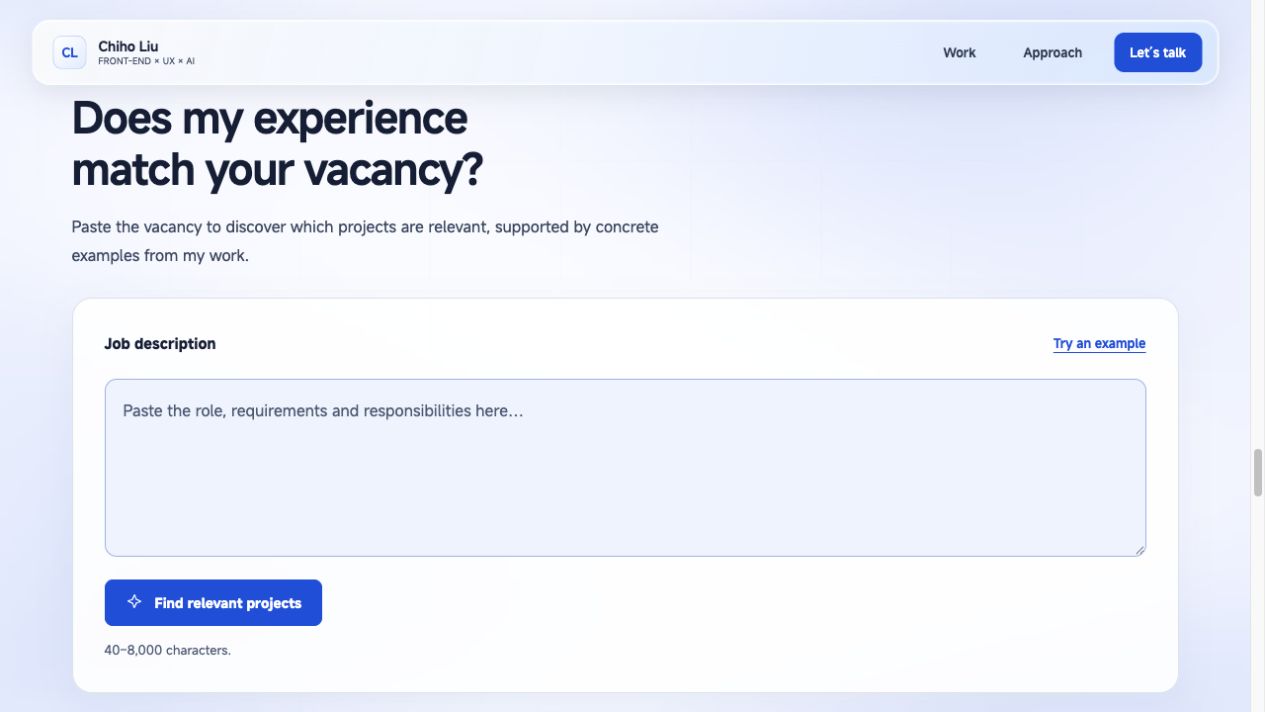
I designed and built the matcher as part of this portfolio. Recruiters can paste a vacancy and immediately see which requirements are supported by concrete project evidence. The experience combines a responsive Next.js interface, a secure server-side gateway and a private Python matching service.
The problem
Generic AI matching tools can sound confident without showing why a candidate fits. A percentage alone is difficult to trust and may hide unsupported assumptions. The challenge was to make the analysis useful for recruiters while keeping every claim traceable to published case-study content.
My contribution
I designed the solution architecture and created the end-to-end product flow and the responsive interface in React, Next.js and TypeScript. The server validates and masks vacancy text, applies origin checks and rate limiting, loads current case studies from Contentful as a headless CMS through GraphQL as a headless CMS through GraphQL and calls an authenticated FastAPI service.
Gemini can extract explicit requirements, while deterministic keyword extraction remains available during provider failures. The Python service ranks only evidence found in the supplied cases. Next.js validates the response again before presenting a requirement-by-requirement explanation.
I also introduced a reviewed evaluation dataset and CI quality gate. It measures requirement precision and recall, evidence accuracy and unsupported claims without consuming AI tokens during normal CI runs.
Planned work
Next, I would expand the versioned evaluation set with more real vacancies and deliberately difficult language. Priority cases include negations, either-or requirements, conditional requirements, less common synonyms and requirements outside the current taxonomy. These additions should be implemented as regression fixtures before changing the matcher logic.
Tech stack
- Next.js
- React
- TypeScript
- Python
- FastAPI
- Gemini
- Contentful
- Zod
- Docker
- GitHub Actions